


AI Product Passports™ — powered by OPEN.MODE

White Paper: Making Products Machine-Readable for Agentic Commerce

We make your brand discoverable, trusted, and sellable by AI shopping agents.
This white paper is a summary from the Digital Product Passports as Agentic Supply Chain Infrastructure: A Strategic Framework for fashion paper.
Date written
January 13, 2026
Authors
Petteri Teikari
Neliana Fuenmayor
-
AI agents are increasingly mediating purchasing decisions. When they query product sustainability claims, what should they trust? Fashion supply chains-now subject to EU Digital Product Passport mandates under ESPR-remain opaque beyond Tier 1 suppliers; most sustainability claims lack the machineverifiable evidence that autonomous purchasing requires. This paper argues that Digital Product Passports must become agentic infrastructure-not compliance documents for humans, but machine-queryable systems enabling autonomous purchasing within calibrated trust boundaries. We propose a confidence governance framework: an assurance stack (A0-A3) encoding verification depth; governance tiers (Autonomous, Recommend, Escalate) routing decisions by uncertainty thresholds; and emerging protocols (AG-UI, A2UI) for human-agent collaboration. The harder challenge is the Oracle Problem-digital assertions about physical products can never be fully verified through digital means. Our framework makes this constraint explicit rather than promising verification it cannot deliver. Transaction cost analysis reveals a novel category: specification costs, the cognitive investment required to articulate preferences in machine-interpretable form. Middle-tier suppliers, not brands, may capture disproportionate value from early adoption. We identify eleven research gaps. A practical implication is that organisations ignoring agent-readable infrastructure risk invisibility to the purchasing systems that increasingly mediate consumer choice.
-
Digital Product Passport, Agentic Supply Chain, Agentic Commerce, Uncertainty Quantification, EU Sustainability Regulation, Supply Chain Transparency, Fashion Supply Chains, Textile Supply Chains
-
Teikari, Petteri and Fuenmayor, Neliana, Digital Product Passports as Agentic Supply Chain Infrastructure: A Strategic Framework for Fashion (January 13, 2026). Available at SSRN: https://ssrn.com/abstract=6068907 or http://dx.doi.org/10.2139/ssrn.6068907
Published by
SSNR on January 22, 2026
The Shift: From SEO to AI-Led Commerce
For twenty years, brands optimised for humans. They built websites, funnels, SEO strategies, and paid acquisition engines.
Now the buyer is changing.
AI systems like ChatGPT, Gemini, and emerging shopping agents are increasingly mediating discovery, evaluation, and purchasing decisions. Instead of browsing, customers will say:
"Buy me a long black evening dress under £500, based on my taste you already know,
I have a gallery opening next week in New York."

AI agents will shortlist products before humans ever see them. This creates a structural shift: if AI cannot understand your product, it cannot recommend it.The Problem
Most product data today is written for marketing, not machines. It lives in PDFs, ERP systems, and product pages — fragmented, unstructured, and impossible for AI to reason over.
At the same time, regulation (ESPR Ecodesign for Sustainable Products Regulation, Digital Product Passport frameworks) is pushing brands toward traceability and structured reporting.
But compliance alone does not equal discoverability. And discoverability alone does not equal trust.
Brands now face a triple challenge:
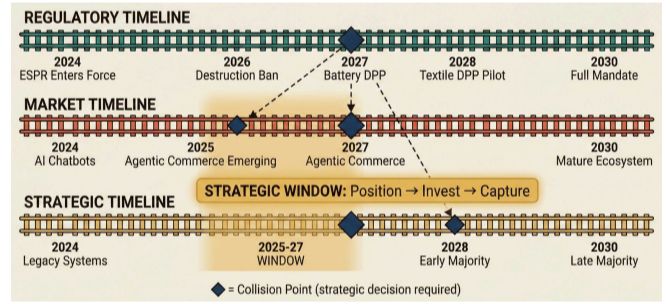
Three colliding timelines creating friction in fashion supply chains: EU regulatory mandates (ESPR) assuming machinereadable data that does not exist; market adoption of AI agents demanding verification infrastructure that lags behind; and strategic investment treating DPP as compliance cost rather than competitive capability. The collision—not convergence—creates urgency for organisations to architect DPP systems with agent accessibility as a design principle.The triple challenge:
Regulatory readiness
Can you report what regulators require?
AI readiness
Can machines parse your product data?
Verification readiness
Can your claims withstand algorithmic scrutiny?
Very few brands are prepared for any of these. Almost none are prepared for all three.
What Is an AI Product Passport™?
It turns product traceability into commercial infrastructure — without overstating what that infrastructure can guarantee.
A live AI Product Passport: materials, origin, confidence scoring, and designer intent — structured for both human browsing and AI agent queries.The Assurance Stack: A0–A3
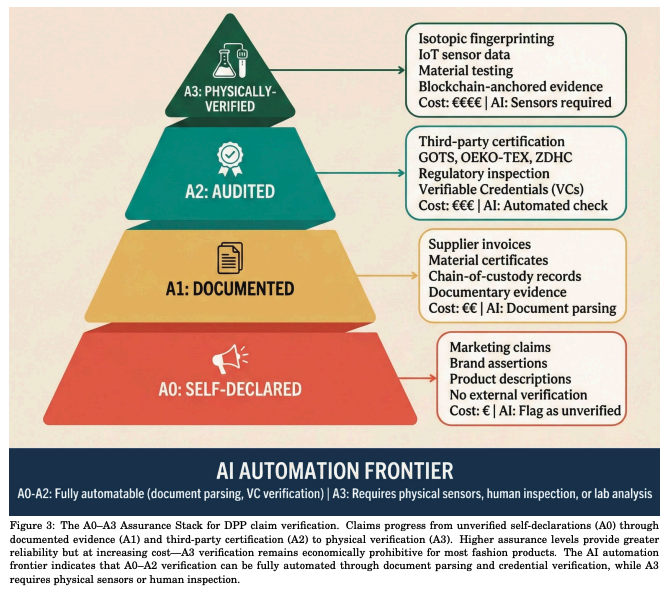
Not all claims carry the same weight. AI Product Passports™ introduce a graduated assurance model:
This allows AI systems to evaluate not just what a product claims — but how deeply that claim has been verified.
Verification depth becomes transparent. Uncertainty becomes calibrated rather than hidden.
Governance Tiers: When Agents Act, Recommend, or Escalate
The assurance stack pairs with built-in decision governance:
Autonomous — High-assurance claims (A2/A3), low-value decisions → agents proceed without human intervention
Recommend — Moderate uncertainty → agents present structured options with confidence ranges to a human decision-maker
Escalate — Low-assurance claims (A0), high-value decisions → mandatory human review
This is not full automation. It is calibrated automation — the system knows what it knows, and knows when to ask.
What an AI Product Passport™ Does
Structures product attributes (materials, origin, certifications) for machine readability
Encodes functional and contextual metadata
Associates every claim with its evidence basis
Applies confidence scoring calibrated to verification depth
Enables query-based discovery by AI agents
Three forces are converging:
Regulation
Digital Product Passport mandates are arriving (EU ESPR)
Commerce is evolving
AI shopping agents are moving from prototype to deployment
Verification demand
Consumers and regulators increasingly reject unsubstantiated claims
Commercial Impact and Strategic Opportunity
What This Means in AI-Mediated Commerce
As AI agents increasingly mediate purchasing, products will be:
Filtered before human visibility
Ranked based on claim clarity and verification depth
Deprioritised if claims are ambiguous, unstructured, or unverifiable
Add caption here for image above
Brands that adopt AI Product Passports™ can:
Increase discoverability in AI shopping interfaces
Improve conversion through transparent, graduated trust signals
Reduce regulatory risk (ESPR compliance as a byproduct, not an add-on)
Turn compliance investment into commercial infrastructure
This is not a marketing layer. It is a structural layer.
The Specification Cost Advantage
Our research identifies a new cost category emerging in AI-led commerce: specification costs — the investment required to articulate product attributes in machine-interpretable form.
Today, these costs are high. Structuring product data for AI readability requires effort across teams, systems, and suppliers. But specification costs are front-loaded: brands that invest now face declining marginal costs as AI commerce scales. Those that wait accumulate specification debt — an increasingly expensive gap between their product data and what AI systems require.
Early movers build infrastructure. Late movers build workarounds.
Value Across the Supply Chain
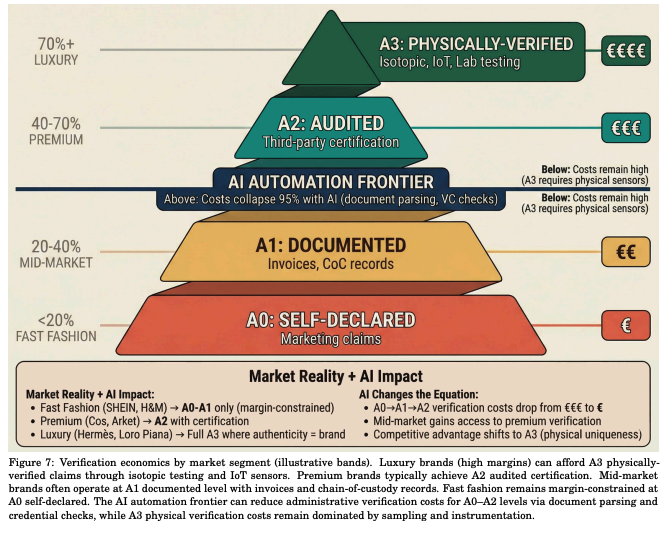
AI Product Passports™ do not only benefit brands. Our analysis suggests that mid-tier suppliers (Tier 1–2) may capture disproportionate value by investing in structured, higher-assurance product intelligence. Suppliers who can demonstrate A1/A2 verification gain algorithmic visibility that generic compliance cannot match.
This creates a differentiation window — one that closes as standards mature and verification becomes commoditised.
What We Are Not Claiming
Intellectual honesty matters. We recognise that:
The Oracle Problem is structural. Full physical-digital verification remains economically prohibitive for most product categories
Most sustainability claims in fashion today sit at A0–A1. That will not change overnight
Algorithmic homogenisation is a real risk — when agents rely on similar models, market diversity can narrow
AI Product Passports™ are infrastructure, not a silver bullet
We believe the framework that makes its limitations explicit is more trustworthy — and ultimately more commercially durable — than one that hides them.

Get Involved
We are currently piloting AI Product Passports™ with selected fashion and lifestyle brands.
Brands
Assess your product data's AI-readiness
E-Commerce
Pilot an AI Product Passport™ across your catalogue
Industry Experts
Explore how your supply chain performs under algorithmic scrutiny
FAQs
What is an AI Product Passport™?
1
A machine-readable product profile that helps AI understand, compare, and recommend your products accurately.
How do AI Product Passports increase sales?
2
When AI understands your products, it recommends them to the right customers — increasing visibility, trust, and conversion.
Why does AI matter for e-commerce now?
3
AI is replacing search and ads as the main way people discover products. If AI can’t read your data, it won’t surface your products.
Do I need to rebuild my tech stack?
4
No. OPEN.MODE is designed to work alongside your existing systems — no re-platforming required.
What's the difference between a DPP and an AI Product Passport?
5
A Digital Product Passport meets regulatory requirements. An AI Product Passport goes further — it makes your product discoverable, comparable, and recommendable by AI shopping agents. Compliance is included.